Another extension to the original operator uses so called uniform patterns [53]. For this, a uniformity measure of a pattern is used: $U$ (“pattern”) is the number of bitwise transitions from 0 to 1 or vice versa when the bit pattern is considered circular. A local binary pattern is called uniform if its uniformity measure is at most 2. For example, the patterns 00000000 (0 transitions), 01110000 (2 transitions) and 11001111 (2 transitions) are uniform whereas the patterns 11001001 (4 transitions) and 01010011 (6 transitions) are not. In uniform LBP mapping there is a separate output label for each uniform pattern and all the non-uniform patterns are assigned to a single label. Thus, the number of different output labels for mapping for patterns of $P$ bits is $P(P-1)+3$. For instance, the uniform mapping produces 59 output labels for neighborhoods of 8 sampling points and 243 labels for neighborhoods of 16 sampling points.
I don’t understand why the number of different LBP output labels is $P(P-1) + 3$. Could someone explain why?…. Thnx for any help =) Update: I think I have some idea already 🙂 I included an example from my book: 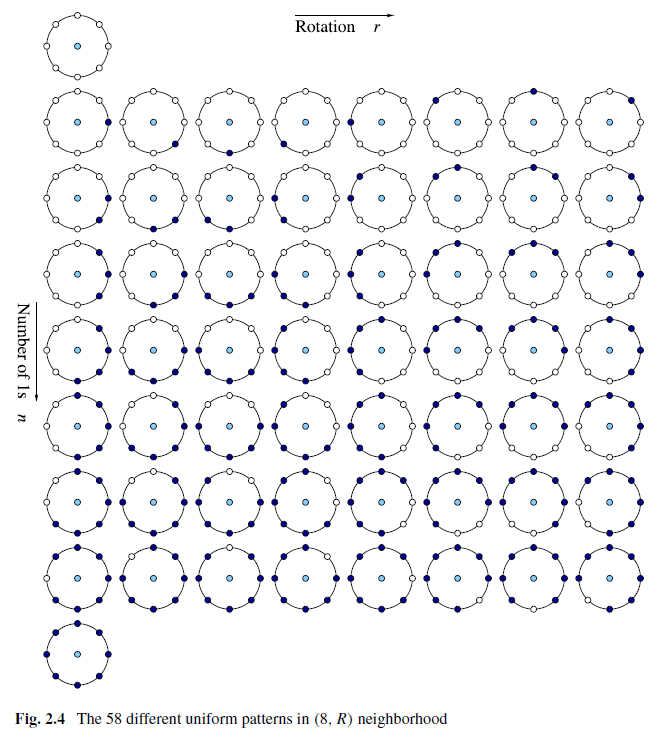
Asked By : jjepsuomi
Answered By : David Richerby
Best Answer from StackOverflow
Question Source : http://cs.stackexchange.com/questions/19844
