
each of the n characters in s1 will cause an iteration through up to n characters in the list from s2.
…which to paraphrase (less succinctly), means “each character in s1 could result in all characters in s2 being inspected”. The following sentence states:
Each of the n positions in the list will be visited once to match a character from s1.
Firstly I’m unsure which list is being referred, I think it means the variable alist, i.e. s2. Is this correct?
The number of visits then becomes the sum of the integers from 1 to n.
Secondly (and the real point of this post), if each item in the list (variable alist) is inspected for each character in s1, then why is this not simply O(n) = n^2 as per “nested loops”? If n=5, then then sum(n) = 15, where as n^2 = 25. I’m fine with simplifying the equation for summing 1 to n integers to get n^2, but I’m confused about how sum(5) = 15, whereas O(n) = n^2. 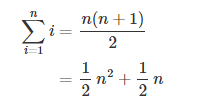 ActiveCode: 1 Checking Off (active5)
def anagramSolution1(s1,s2): alist = list(s2) pos1 = 0 stillOK = True while pos1 < len(s1) and stillOK: pos2 = 0 found = False while pos2 < len(alist) and not found: if s1[pos1] == alist[pos2]: found = True else: pos2 = pos2 + 1 if found: alist[pos2] = None else: stillOK = False pos1 = pos1 + 1 return stillOK print(anagramSolution1('abcd','dcba')
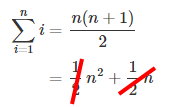
Edit to add Having written this out it struck me that perhaps dropping the (1/2) and (1/2)n from the formula to sum(n) is the reason for the difference of actually summing n, as opposed to just doing n^2. To be absolutely clear, I understand the formula for summing n is n^2 when dropping the non-dominant terms. What I don’t understand is why we’re summing n and not immediately and directly stating it is actually n^2 as a result of the nested loop and this sentence:
each of the n characters in s1 will cause an iteration through up to n characters in the list from s2.
Asked By : Jack
Answered By : unutbu
Best Answer from StackOverflow
Question Source : http://cs.stackexchange.com/questions/33618
