
we have books with heights $H_n,$ $1 le n le N$ and widths $W_n,$ with heights in ascending order for each book, and we want to group them into shelves. Reuse these numbers for solution nodes $n,$ where that node represents a solution state “all books $i le n$ have been shelved.” We will therefore start at node $0$ and seek to get to node $N$ by the shortest path with Dijkstra’s algorithm. These nodes are the vertices of our graph. We then draw from node $i$ to any node $j gt i$ a directed edge which assumes that all of those intermediary books will be shelved with one shelf, i.e. the length of this edge is $$L_{ij} = F_j + C_j~sum_{n=i+1}^j W_n,$$where I have assumed that when you were saying the cost of the sum was $F_i + C_i x_i$ the subscript $i$ on the $x_i$ was totally meaningless. Dijkstra’s algorithm will then give us a shortest-length path to node $N.$
With such an array, showing how many books do we have of length $H_i$ with $L_i$ meters of documents of $type i$, and the cost of storing such documents: $F_i$ a fixed command cost and $C_i$ the varying cost accorfing to $x_i$ the length of documents we would store within it, begin{array}{|c|rr} i & 1 & 2 & 3 & 4 hline H_i & 12,mathrm{cm} & 15,mathrm{cm} & 18,mathrm{cm} & 23,mathrm{cm} L_i & 100,mathrm{cm} & 300,mathrm{cm} & 200,mathrm{cm} & 300,mathrm{cm} hline F_i & 1000€ & 1200€ & 1100€ & 1600€ C_i & 5€/mathrm{cm} & 6€/mathrm{cm} & 7€/mathrm{cm} & 9€/mathrm{cm} end{array} The graph is: 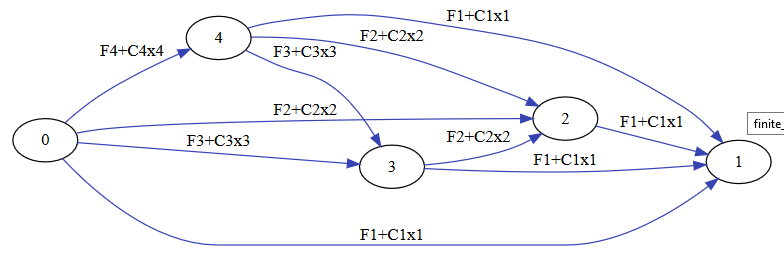 My question is: why should we use a Djikstra algorithm? We don’t have any circuits and we can’t go backward. Therefore, shouldn’t we use Bellman-Kalaba algorithm?
Asked By : Marine1
Answered By : D.W.
Best Answer from StackOverflow
Question Source : http://cs.stackexchange.com/questions/48977 Ask a Question Download Related Notes/Documents
