Definition: A Binary Tree is called $mu$-balanced, with $0 le mu leq frac{1}{2}$, if for every node $N$, the inequality $$ mu le frac{|N_L| + 1}{|N| + 1} le 1 – mu$$ holds and for every $mu' gt mu$, there is some node for which the above statement fails. $|N_L|$ is the number of nodes in the left sub-tree of $N$ and $|N|$ is the number of nodes under the tree with $N$ as root (including the root).
I believe, these are called weight-balanced trees in some of the literature on this topic. One can show that if a binary tree with $n$ nodes is $mu$-balanced (for a constant $mu gt 0$), then the height of the tree is $mathcal{O}(log n)$, thus maintaining the nice search properties. So the question is:
Is there some $mu gt 0$ such that every big enough red-black tree is $mu$-balanced?
The definition of Red-Black trees we use (from Introduction to Algorithms by Cormen et al): A binary search tree, where each node is coloured either red or black and
- The root is black
- All NULL nodes are black
- If a node is red, then both its children are black.
- For each node, all paths from that node to descendant NULL nodes have the same number of black nodes.
Note: we don’t count the NULL nodes in the definition of $mu$-balanced above. (Though I believe it does not matter if we do).
Asked By : Aryabhata
Answered By : Raphael
- $R_k$ the complete tree of height $2k – 1$ with the first, third, … level colored red, the others black, and
- $L_k$ the complete tree of height $k-1$ with all nodes colored black.
Clearly, all $T_k$ are red-black trees. For example, these are $T_1$, $T_2$ and $T_3$, respectively: 
[source] 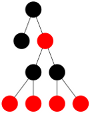
[source] 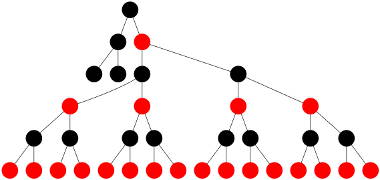
[source] Now let us verify the visual impression of the right side being huge compared to the right. I will not count virtual leaves; they do not impact the result. The left subtree of $T_k$ is complete and always has height $k-1$ and therefore contains $2^k – 1$ nodes. The right subtree, on the other hand, is complete and has height $2k – 1$ and thusly contains $2^{2k}-1$ nodes. Now the $mu$-balance value for the root is $qquad displaystyle frac{2^k}{2^k + 2^{2k}} = frac{1}{1 + 2^k} underset{ktoinfty}{to} 0$ which proves that there is no $mu > 0$ as requested.
Best Answer from StackOverflow
Question Source : http://cs.stackexchange.com/questions/342
