
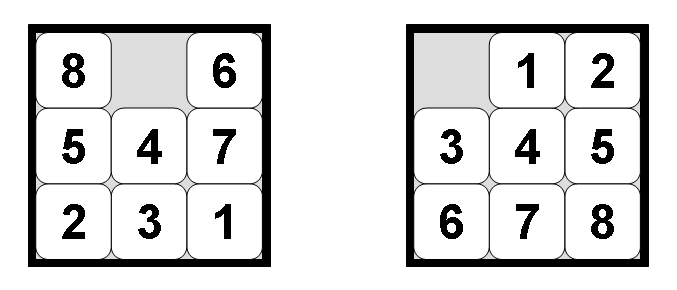
Asked By : Cam
Answered By : Vor
1 2 3 4 5 6 7 8 9 10 11 12 13 14 15 *
Given a state $S$ a permutation inversion is a tile $T_i$ that is placed after $T_j$ but $i < j$; this happens when (a) $T_i$ is in the same row of $T_j$, but on its right, or (b) $T_i$ is in a lower row:
. . . . . . . . 3 . . 1 . 7 . . . . . . . 5 . . . . . . . . . . (a) (b)
We define $N_j$ as the number of tiles $T_i$, $i < j$ that appears after $T_j$. For example, in the state:
1 2 3 4 5 10 7 8 9 6 11 12 13 14 15 *
we have that after $T_{7}$ there is one tile ($T_6$) that should be before it, so $N_7=1$; after $T_{10}$ there are four tiles ($T_7, T_8, T_9, T_6$) that should be before it, so $N_{10}=4$. Let $N$ be the sum of all $N_i$ and the row number of the empty tile $T_{Box}$ $$N = sum_{i=1}^{15} N_i + row(T_{Box})$$ In the example above we have: $N = N_7 + N_8 + N_9 + N_{10} + row(T_{Box}) = 1 + 1 +1 + 4 + 4=11$ We can notice that when the empty tile is moved horizontally $N$ doesn’t change; if we move the empty tile vertically $N$ changes by an even quantity. For example:
. . . . . . . . . . 2 3 . . * 3 4 5 * . 4 5 2 . . . . . . . . .
$N’ = N + 3 mbox{ (2 is placed after 3,4,5)} – 1 mbox{ (empty tile is moved up)} = N + 2$
. . . . . . . . . . * 4 . . 3 4 2 5 3 . 2 5 * . . . . . . . . .
$N’ = N + 1 mbox{ (2 is placed after 3)} – 2 mbox{ (4,5 are placed after 3)} + 1 mbox{ (empty tile is moved down)} = N$ So $N bmod 2$ is invariant under any legal move of the empty tile. We can conclude that the state space is split in two disconnected halves, one having $N bmod = 0$ and the other having $N mod 2 = 1$. For example the following two states are not connected:
1 2 3 4 1 2 3 4 5 6 7 8 5 6 7 8 9 10 11 12 9 10 11 12 13 14 15 * 13 15 14 * N = 4 N = 5
Best Answer from StackOverflow
Question Source : http://cs.stackexchange.com/questions/16515
